
The Construction Products Regulation (CPR) has been adopted by the European Commission and UK Government and replaces the Construction Products Directive (CPD).
As a result of the change, CE marking will soon become mandatory in the UK. Manufacturers and importers have until July 2013 to ensure that their construction products meet the CE requirements of the new Regulation.
NEW Thermal Performance Verification Service from BSI
On the 1st July 2013 the Construction Products Regulation (CPR) became effective. As part of CPR the calculations for the thermal performance of windows and doorsets now need to be verified by a Notified Body. As a Notified Body BSI can help you with this.
What is the BSI Thermal Performance Service?
BSI has developed an innovative verification process that allows a large number of previously calculated ‘U’ values to be verified giving manufacturers the opportunity to quickly and easily gain the required verification. As we take into account simulations previously performed this allows a wide range of products to be covered which minimises additional work.
Why do you need this?
This is a legal obligation. To sell your windows and doorsets they will need to be CE marked. This requires the implementation of factory production control, declaration of safety devices, dangerous substances and thermal performance. The evidence supporting these declarations must be based on work carried out by a Notified Body such as BSI.
What is the process?
First of all, BSI conducts an on-site assessment. Following the successful implementation by the manufacturer of any required actions, we will then produce a Notified Body Initial Type Test (ITT) report. This will cover the full range of products which allows you to make the appropriate declaration of Thermal Performance under CE marking.
According to the Regulation, the requirement for CE marking will apply to:
“any product or kit which is produced and placed on the market for incorporation in a permanent manner in construction works or parts thereof and the performance of which has an effect on the performance of the construction works with respect to the basic requirements for construction works.”
Any products that fall under this definition that are placed on the market from July 2013 and are covered by a harmonised standard, will have to be accompanied by a Declaration of Performance and will need to display the CE mark.
The move to CPR builds on the success of the CPD, allowing construction products that have been assessed against harmonised standards to be legally placed on the market anywhere in the European Economic Area.
How does CPR affect you?
If you manufacture or import products that are within the scope of the Regulation, you will be required to declare that the product complies with the Regulation and display the CE mark, before they can be sold in the UK and Europe.
The responsibility for ensuring that a product has the correct characteristics for a particular application rests with the building designers, contractors and local building authorities, and manufacturers and importers will be required to provide the necessary testing evidence.
How can BSI help you prepare for CPR?
As more and more harmonised European standards are published, CE marking is applicable to an ever-increasingly number of construction products under the Construction Products Directive (CPD).
Manufacturers continue to face a complex global market place, affected by multiple regulatory systems, international and national standards and certification requirements. This complex environment is dynamic, influenced by many national and international forums and initiatives, particularly the drive towards global harmonisation.
What is available already?
The classification splits cables into 7 classes in respect of their reaction to fire. They range from Class Aca, being essentially non-combustible, as for instance bare MICC, through to class Fca, which is for cables having no measurable resistance to the spread of flames. All classes are summarised in Annex A. For the vast majority of practical purposes, it will be the classes from Eca up to B2ca that are most likely to be applicable. By reference to existing requirements in BS 7671 the significant comparisons are:
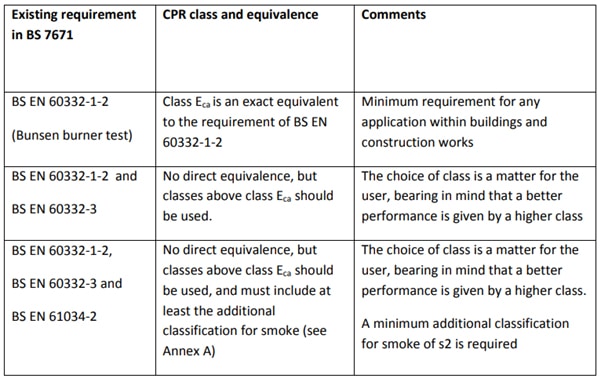
Cautionary Notes
Bearing in mind that the legalistic position is that any class automatically satisfies the requirements of the classes below, and hence for instance class Cca is automatically “better” than class Dca, it may be tempting to play safe and specify the highest possible class. This should not be done without being sure that every family of cable to be used in a particular construction works is available, with the necessary authentication, i.e. DoP and CE marking derived from certification via a Notified Body. Furthermore, it should be recalled that the position of cables under CPR at present relates only to two Essential Requirements, or as they are properly called Basic Requirements of Construction Works (BRCW).
These are:
- Reaction to fire
- Dangerous substances
A cable that satisfies only these BRCWs is almost certainly not fit for purpose. Electrical and mechanical performance are covered via existing standards and users should ensure that the relevant performances for these requirements, are also satisfied, for instance in UK via a 3rd party certification and approval system, such as BASEC.
British Cable Association (BCA) recommendations
Taking account of all the above factors, and recognising that a very wide range of buildings and construction works are embraced by CPR, BCA recommends that specifiers should adopt the following guidance for the use of cables under the regulation:
- Always specify that cables must have the CE marking according to CPR, accompanied by a Declaration of Performance;
- Specify cables of class ECA or higher;
- Preferably use cables described as a low fire hazard or equivalent (LSHF, LSOH, OHLS, LSNH etc), in particular where fire safety requirements are high or very high;
- Ensure that low fire hazard cables above class Eca include the additional classifications for smoke, acidity and, for particular applications, flaming droplets;
- Avoid cables classified as FCA, as they are likely to burn uncontrollably in a fire;
- In case of doubt, consult the manufacturer.

¹ The level of reaction to fire performance decreases in going from Class ACA to Class FCA
² The full description of the classification criteria, the symbols used and the numerical values of reaction to fire performance are given in the Commission delegated regulation (EU) 2016/364 of 1 July 2015 (L 68/4 – 15 March 2016). These will eventually be taken into an updated version of EN 13501-6 Fire classification of construction products and building elements – Part 6: Classification using data from reaction to fire tests on electric cables
³The additional classifications apply only to Classes B1, B2, C and D. They are optional but should be regarded as essential for use with cables described as “low smoke” and/or “halogen-free”. Their full description can be found in the same documents as for footnote 2 above