
Introduction
Organising through cables and connectivity options can be an exasperating exercise. It’s tough enough working through the categories and levels of copper networking cables, where most cables end with the same connector. When you start looking at fibre optic cables, things can really get confusing. This white paper is designed to help you select the right kind of fibre optic cable. It should also help you in understanding the various fibre optic connectors in the market and get you up and running in no time. Please note that there are many types of connectors and variants available. Perhaps, we will only be covering the most commonly used ones here.
Fibre optic cables can be used in a huge variety of applications, from small office LANs to data centres, to inter-continental communication links. Our discussion in this paper is going to focus primarily on the types of cables found in those small-scale networks closer to home, and in particular to pre-terminated cables that may be readily available for installation, called “patch cords”, “pre-terms”, or other similar nicknames.
Proper selection of fibre optic cables and connectors for specific uses are becoming more and more important as fibre optic systems become the transmission medium for communications and aircraft applications, and even antenna links. Choices must be made in selecting fibre optic cables and connectors for high-reliability applications. This white paper provides the knowledge for how to make appropriate selections of fibre optic cable and connector when designing a fibre optic system.
Selecting Fibre Optic Cable
To select a fibre optic cable, you have to make choices of the fibre selection and the cable construction selection.
A. Fibre Selection
The three major fibre parameters used in selecting the proper fibre for an application are bandwidth, attenuation and core diameter.
Bandwidth: The bandwidth at a specified wavelength represents the highest sinusoidal light modulation frequency that can be transmitted through a length of fibre with an optical signal power loss equal to 50 per cent of the zero-modulation frequency component. The bandwidth is expressed in megahertz over a kilometre length (MHz/km).
Attenuation: The optical attenuation denotes the amount of optical power lost due to absorption and scattering of optical radiation at a specified wavelength in a length of the fibre. It is expressed as an attenuation in decibels of optical power per kilometre (dB/km). The attenuation is determined by launching a narrow spectral band of light into the full length of the fibre and measuring the transmitted intensity.
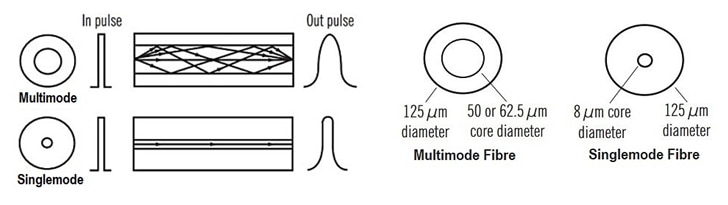
Core Diameter: The fibre core is the central region of an optical fibre whose refractive index is higher than that of the fibre cladding. Various core diameters are available to permit the most efficient coupling of light from commercially available light sources, such as laser diodes. There are two basic fibre types, Single Mode and multimode. Single Mode fibre has a core diameter of 8 to 10 microns and is normally used for long-distance requirements and high- bandwidth applications. Multimode fibre has a core diameter of 50 or 62.5 microns and is usually used in buildings. The below picture shows Single Mode and multimode fibre with different core diameters.
B. Cable Construction Selection
Another important consideration when specifying optical fibre cable is cable construction. There are three main types of cable configurations: buffered fibre cable, simplex cable and multichannel cable.
Buffered Fibre Cable – There are two kinds of buffered fibre:
The first is a loose buffer tube construction where the fibre is contained in a water-blocked polymer tube that has an inner diameter considerably larger than the fibre itself. The loose buffer tube construction offers lower cable attenuation from a given fibre and a high level of isolation from external forces. Loose buffer cables are typically used in outdoor applications and can accommodate the changes in external conditions.
Loose tube fibre optic cables are composed of several fibres together inside a small plastic tube, which is in turn wound around a central strength member and jacketed, providing a small, high fibre count cable. They are suitable for outside plant trunking applications because they can be made with loose tubes filled with gel or water absorbent powder to prevent harm to the fibres from water. Since the fibres have only a thin buffer coating, they must be carefully handled and protected to prevent damage. They can be used in conduits, strung overhead or buried directly into the ground. Generally, fibre optic cables installed in outdoor applications contain loose tube fibre optic cable, ribbon fibre optic cable, armoured fibre optic cable and aerial fibre optic cable.

Single Loose Tube Fibre Optic Cable

Loose Tube Steel Tape Armoured Cable

Tight Buffered Distribution Cable

A comparison of the two cable constructions is shown above.
Simplex Cable: A simplex fibre optic cable has only one tight-buffered optical fibre inside the cable jackets. Simplex fibre optic cables are typically categorised as interconnect cables and are used to make interconnections in front of the patch panel. They are designed for production termination where consistency and uniformity are vital for fast and efficient operation.
Multichannel Cable: Building multiple fibres into one cable creates a multichannel cable. This type of cable is usually built with either a central or external strength member and fibre bundled around or within the strength member. An external jacket is used to keep the cable together.
The major difference between indoor and outdoor fibre optic cable is water blocking. Any conduit is someday likely to get moisture in it. Outdoor cables are designed to protect the fibres from years of exposure to moisture. Indoor cables are what we call “tight-buffered” cables, where the glass fibre has a primary coating and secondary buffer coatings that enlarge each fibre to 900 microns—about 1mm or 1/25-inch, to make fibre easier to work with.
Checking the outer jacket is also important during the selection. Fibre optic cable jackets can provide strength, integrity and overall protection of the fibre member. The standard jacket type of optical cable is called OFNR (Optical Fibre Non-conductive Riser). Fibre optic patch cords are also available with OFNP, or plenum jackets, which are suitable for use in plenum environments such as drop-ceilings or raised floors. The other option for the jacket type is LSZH (Low Smoke Zero Halogen), which is a jacket made from special compounds which give off very little smoke and no toxic halogenic compounds when burned. Therefore, please check with the local fire code authority to be sure of the requirements of the installation before making the jacket selection.
Selecting Fibre Optic Connector
The connector is an integral component of the cabling system infrastructure, which keeps the information flowing from cable to cable or cable to device. There are various connector types, including LC, FC, ST, SC, MTRJ, MPO, MTP, DIN, E2000, MU, etc. To design a fibre optic system, optical connector selection is also a very important decision. When selecting an optical connector, you have to take polishing styles, fibre type, the number of fibres, connector body, coupling mechanism and colour code all into consideration.
Polishing Styles: There are mainly three kinds of polishing styles, PC (physical contact), APC (angled physical contact), and UPC (ultra physical contact). PC, UPC and APC refer to how the ferrule of the fibre optic connectors is polished. PC connector is used in many applications. UPC connectors are often used in digital, CATV, and telephony systems. APC connectors are preferred for CATV and analogue systems. The below picture shows these three kinds of polishing styles.

The above picture shows these three kinds of polishing styles.
Fibre Types
Single-mode and multimode optical fibre are two commonly used fibre types. Accordingly, there are Single-mode optical connector and multimode optical connector. ST and MTRJ are the popular connectors for multimode networks. LC connector and SC connector are widely used in Single Mode systems. Single-mode fibre optic connectors can be with PC, or UPC or APC polish, while multimode fibre optic connectors only with PC or UPC polish.
Number of Fibres
A simplex connector means only one fibre is terminated in the connector. Simplex connectors include FC, ST, SC, LC, MU and SMA. A duplex connector means two fibres are terminated in the connector. Duplex connectors include SC, LC, MU and MTRJ. Multiple fibre connector means more than two fibres (for up to 24 fibre) are terminated in the connector. These are usually ribboned fibres with fibre count of 4, 6, 8, 12 and 24. The most popular ribbon fibre connector is the MT connector.
Connector Body
The connector body is the structure that holds the ferrule, the coupling mechanism and the boot. It is made of plastic or metal.
Coupling Mechanism
A coupling mechanism mates the connector with the device it has to be attached to. A report says that the coupling mechanism can be push-pull or bayonet.
Colour Code
According to the TIA 568 colour code, connectors with beige bodies or boots work with multimode fibre, blue ones with single-mode fibre and green for APC connectors says the connector identifier guide from the Fibre Optics Association.
There are many different types of fibre optic connectors, and there are also various ways to install them. There are only a few types that are used in most applications, though. The common fibre optic connector types include ST, FC, SC, LC, MU, E2000, MTRJ, SMA, DIN as well as MTP and MPO and so on. Each one has its own advantages, disadvantages, and capabilities. All fibre optic connectors have four basic components, which are the ferrule, connector body, cable, and coupling device. They have been widely used in the termination of fibre optic cables, such as fibre optic pigtail, fibre optic patch cables and so on. Different connectors and splice termination procedures are used for Single-mode and multimode connectors. Here’s a rundown of the different types of fibre optic connectors:
ST (Straight Tip) – Simplex only, twist-on mechanism.
Available in Single-mode and multimode. It is the most popular connector for multimode fibre optic LAN applications. It has a long 2.5mm diameter ferrule made of ceramic (zirconia), stainless alloy or plastic. It mates with an interconnection adaptor and is latched into place by twisting to engage a spring-loaded bayonet socket.
FC (Ferrule Connector) – Simplex only, screw-on mechanism.
Available in Single-mode and multimode. FC connector also has a 2.5mm ferrule made of ceramic (zirconia) or stainless alloy. Although this has been one of the most used types of Single Mode connectors, it is being replaced by SCs and LCs.
SC (Subscriber Connector) – Simplex and duplex, snap-in mechanism.
Available in Single-mode and multimode. SC was developed by NTT of Japan. SC connector is a non-optical disconnect connector with a 2.5mm pre-radiused zirconia or stainless alloy ferrule. It features a snap-in (push-pull) connection design for quick patching of cables into a rack or wall mounts. Two simplex SC connectors can be clipped together by a reusable duplex holding clip to create a duplex SC connector.
LC (Lucent Connector) – Simplex and duplex, push and latch mechanism.
Available in Single-mode and multimode. This new type of connector offers excellent performance and is preferred for Single-mode systems. It uses a 1.25 mm ferrule.
MU (Miniature Unit) – Simplex and duplex, snap-in, mechanism, 1.25mm ferrule.
MU connectors and adaptors were developed by NTT and have a push-pull mechanism. They are called “mini SC” and are more popular in Japan. Applications include high-speed data communications, voice networks, telecommunications, and dense wavelength division multiplexing (DWDM). MU connectors are also used in multiple optical connections and as a self-retentive mechanism in backplane applications.
E2000 – Snap-in mechanism, 1.25mm ferrule. Also called as LX.5 connector.
Available in Single-mode and multimode. Externally the E2000 connector looks like a miniature SC connector. The connector is easy to install, with a push-pull latching mechanism that clicks when fully inserted. It features a spring-loaded shutter that fully protects the ferrule from dust and scratches. The shutter closes automatically when the connector is disengaged, locking out impurities that could later lead to network failure, and locking in potentially harmful laser beams. When it is plugged into the adaptor the shutter opens automatically.
MTRJ (Mechanical Transfer Registered Jack)
A multimode duplex connector (not 1.25mm ferrule, but rather a two-fibre ferrule design derived from MT). Overall size is about the same as an RJ45 connector. It contains both fibres in a single polymer ferrule. It uses pins for alignment and is available in male and female versions.
MPO/MTP® (Multiple-Fibre Push-On/Pull-off)
MTP Fibre Connector or Multiple-Fibre Termination Push- On/Pull-off is a brand name for a connector developed by US CONEC® and is an improved high- performance version of an MPO Connector. MTP connectors are compatible with MPO connectors. The most common MTP connectors contain 12 fibres but can go up to 24 fibres in newer designs. connectors feature male and female connector design. Male connectors have two guide pins and female connectors do not. Both connector types need an adaptor to mate a pair of male and female connectors. Because MTP and MPO connectors are trying to align so many fibres at once, their coupling loss are typically bigger than single fibre connectors

ST, FC, SC AND E2000 connectors

LC 1.25nn Connectors
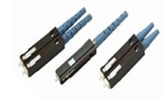
MU 2.5mm Connectors
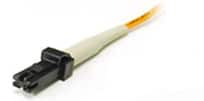
MPO MTP Multi Push Optical Fibre
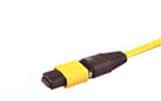
MPO MTP Multi Push Optical Fibre
Conclusion
The key to designing a successful fibre optic system is understanding the performance and applications of different kinds of fibres, cable constructions and optical connectors, and then utilising the appropriate components.
Fibre optic cables can be available in Single-Mode, multimode, or polarisation maintaining, and they can meet the strength and flexibility required for today’s fibre interconnect applications. For an optical fibre connector to be considered the best it needs to have low insertion loss, low cost and be easy to terminate. With the wide variety of fibre optic connectors available today, companies can easily convert to fibre optic networks and start enjoying the benefits of a faster, more efficient work environment. BCP provides a wide range of fibre optic cables and connectors, offering a customised service. You can custom simplex/duplex, Single-Mode/multimode, UPC/APC, 900μm/2.0mm/3.0mm fibre optic connector here. The fibre optic connect market ahead will be more buoyant, we shall see.
When choosing the fibre optic cable and connectivity, please always remember the elements mentioned in this white paper. With these aspects, you can make the selection that most suits your applications. If you are still confused about which one to choose, you can contact us to seek help, as lots of professional advice can be given by the Britanic Cabling Production team.